Favorites0 items in wishlist
The goal of Lindner brand communications is a consistent presence across all Lindner Group channels – particularly on the website, social media, in PR and HR. Yet consistency does not arise from guidelines alone. It arises when everyone who speaks and writes for Lindner lives the same brand language.
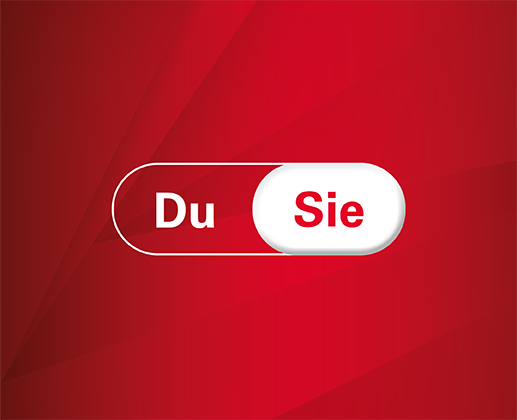
The formal "Sie" form of address applies to all external communications as well as official internal information from Management and Human Resources.
Internally, Lindner largely operates on a first-name basis using "du"; however, for colleague-facing materials such as invitations or flyers, the "Bavarian Sie" (ihr/euch) is used.
In external training communications, as well as in social media and advertising campaigns, the informal "du" form is expressly permitted. For job advertisements, the form of address is determined by the candidate persona defined by Human Resources or the respective job family.

The Lindner Group brand voice unites technical precision with familial warmth and the closeness of a true partnership.
Internally, we communicate in a collegial and personal manner – shaped by the Bavarian "Sie" (ihr/euch), which gives way to the formal "Sie" in official communications from Management or Human Resources.
Externally, Lindner communicates in a professional and assured manner, while exceptions such as apprenticeship campaigns or social media are deliberately permitted a more casual tone.
Stylistic guidelines such as "Innovative. Pragmatic. Familiar." encapsulate our ambition: competent solution orientation paired with a down-to-earth culture.

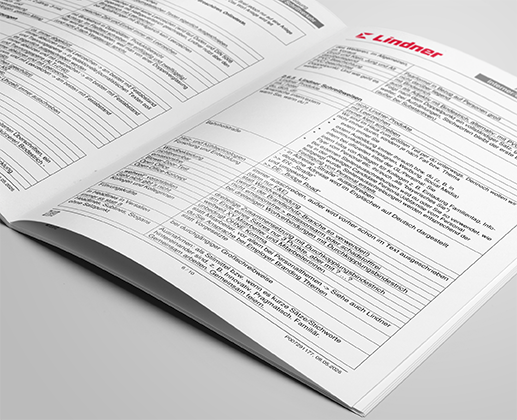
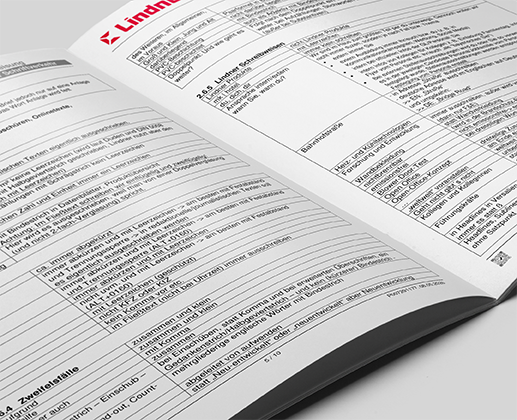
The Lindner Group wording and terminology guidelines are based on a central glossary from which all phrasing and a clearly defined set of rules can be drawn.
Established conventions for product and division names, units of measurement and technical terms, as well as a list of permitted and prohibited terms, prevent deviations across all channels and ensure a consistent, professional brand presence.
Sample letters and central templates support the uniform application of these standards throughout all correspondence.

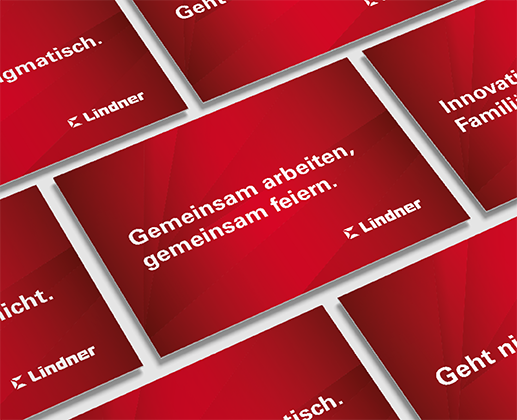
Headlines, sublines and slogans generally end without a full stop. Exceptions apply as a deliberate stylistic device for short consecutive sentences or keywords, such as "Innovative. Pragmatic. Familiar." or "Working together. Celebrating together.".
The expression "Geht nicht gibt's nicht" is written without a comma.
Strict guidelines apply to environmental claims to avoid greenwashing: blanket statements such as "environmentally friendly", "green" or "climate neutral" are prohibited unless based on demonstrably recognised outstanding environmental performance. Climate neutrality claims based exclusively on offsetting (e.g. CO2 certificates) are restricted.
Content-related claim approvals or campaign-specific allocations must be coordinated with our Marketing department where applicable.

Our language is clear, respectful and authentic. Throughout all written communications, we maintain a consistent style – from dates, figures and units of measurement to abbreviations and addresses.
We address everyone on an equal footing: we avoid asterisks, colons or hyphens as gender markers; instead, we use both genders or gender-neutral terms such as "executives" and "team".
We reject generic environmental claims; we communicate sustainability with concrete data and verifiable certificates.

With the adoption of the Directive on Empowering Consumers for the Green Transition (the so-called EmpCo Directive, EU 2024/825), the EU has introduced binding requirements for environmental claims in advertising. The directive aims to prevent greenwashing – that is, misleading or unsubstantiated environmental claims in corporate communications – and to strengthen customer trust in sustainable products and services.
Sustainability communications at Lindner Group are implemented in a compliant, transparent and consistent manner.
Approved templates for letters, file notes and other documents are stored for each company on myLindner under "Templates".
New letter templates may only be created by the Marketing department.